Perinatal Counselling in Singapore
Support for your mental health in pregnancy, after birth and through the first year of parenthood.
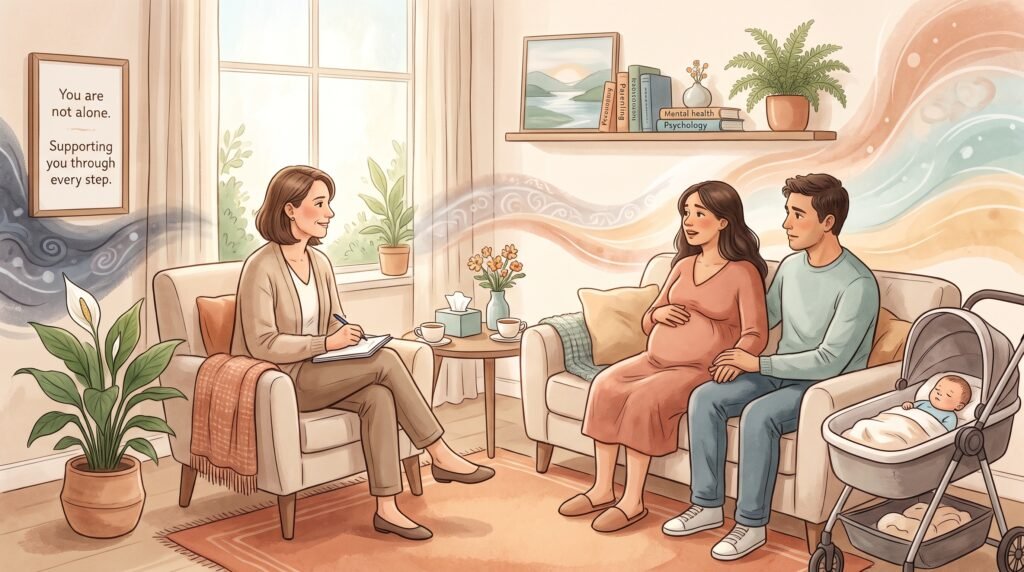
Becoming a parent is one of the biggest changes a person can go through. Alongside the joy, many people feel things they did not expect: worry that will not switch off, low mood, frightening thoughts, or a sense that they are no longer themselves.
You are not alone. You are not to blame. With the right help, you can feel well again. At Relate Works, we offer confidential perinatal counselling for mothers, fathers, partners and couples in Singapore.
What is perinatal mental health?
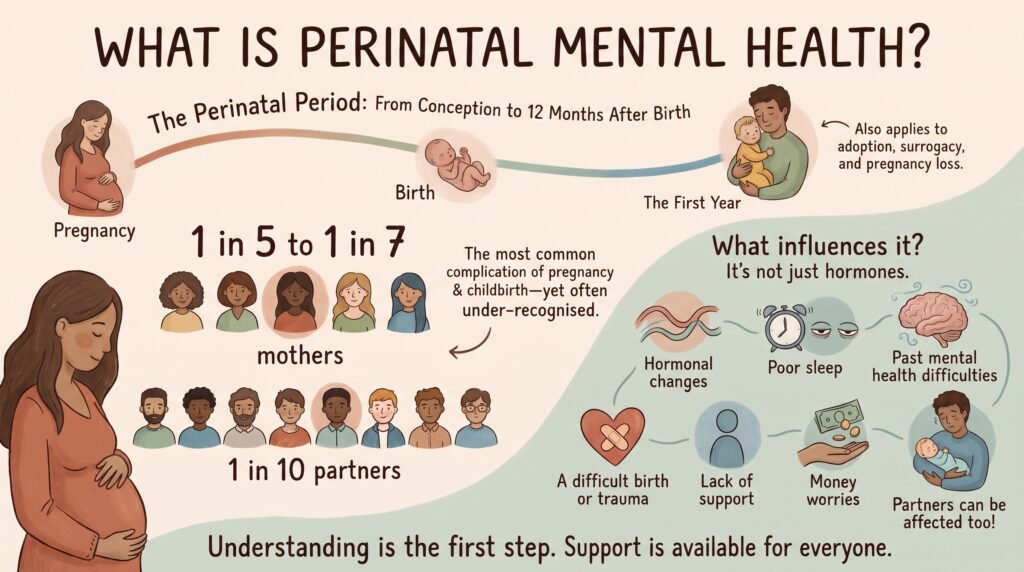
The perinatal period runs from conception to 12 months after birth. It includes pregnancy (the antenatal period) and the first year after birth (the postnatal or postpartum period). It also applies after adoption, surrogacy and pregnancy loss.
Perinatal mood and anxiety disorders (PMADs) are the most common complication of pregnancy and childbirth. About 1 in 5 to 1 in 7 mothers and about 1 in 10 fathers are affected. They are also among the most under-recognised.
Hormonal changes do not cause these conditions on their own. They can make some people more vulnerable, especially alongside poor sleep, past mental health difficulties, trauma, a difficult birth, money worries or a lack of support. Partners who did not give birth can be affected too.
Is it the baby blues or something more?
Up to 80% of new mothers have the “baby blues”. These usually start a few days after birth and settle within two weeks. You may feel tearful and overwhelmed, but you still feel like yourself.
If difficult feelings last longer than two weeks, are present most days, or get in the way of daily life, it is worth speaking to someone. Common perinatal conditions include:
- Perinatal depression: low mood, feeling empty or disconnected from your baby, guilt, exhaustion that rest does not fix. It can also show up as irritability or rage.
- Perinatal anxiety: racing, chaining worries, trouble falling asleep even when the baby sleeps, a tight chest or clenched jaw.
- Panic attacks: sudden waves of fear, a racing heart or breathlessness that can feel like a heart attack.
- Perinatal OCD: unwanted, intrusive thoughts or images, often about harm coming to the baby, with checking, avoiding or seeking reassurance. These thoughts go against who you are, and they are far more common than most parents realise.
- Birth trauma and PTSD: flashbacks, nightmares, feeling on edge, or avoiding reminders of a frightening birth, NICU stay or medical emergency.
- Grief after pregnancy loss, stillbirth or infertility: sorrow that others may not see or acknowledge.
How perinatal psychotherapy helps
Therapy gives you a safe, unhurried space to make sense of what is happening and to feel more like yourself again. Many people with mild to moderate symptoms recover well with psychotherapy alone. For more severe symptoms, therapy works best alongside medical care.
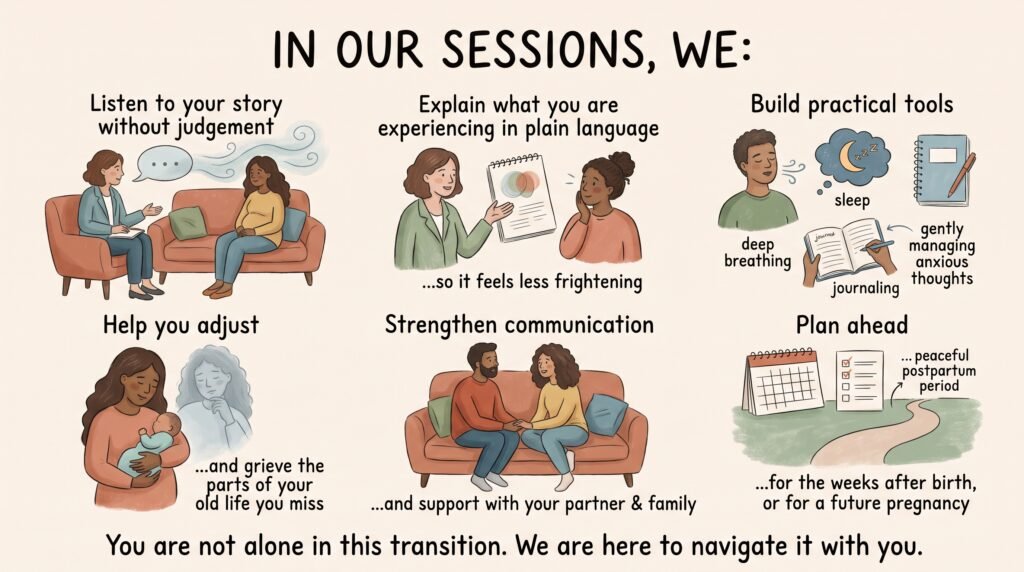
In our sessions, we:
- Listen to your story without judgement, including the parts that are hard to say aloud
- Explain what you are experiencing in plain language, so it feels less frightening
- Build practical tools for anxiety, low mood, sleep and intrusive thoughts
- Help you adjust to your new role and grieve the parts of your old life you miss
- Strengthen communication and support with your partner and family
- Plan ahead for the weeks after birth, or for a future pregnancy
Our therapeutic approaches
We use approaches with strong evidence in the perinatal period, tailored to you.
- Interpersonal Psychotherapy (IPT): a structured therapy, usually 12 to 16 sessions, that focuses on role changes, relationships, support and loss. It is one of the best-researched treatments for perinatal depression.
- Cognitive Behavioural Therapy (CBT): helps you notice and gently challenge thoughts such as “I’m a bad mother” and change patterns that keep anxiety and low mood going.
- Trauma-focused therapy for birth trauma: Cognitive Processing Therapy alongside grounding and body-based techniques that help you feel safe in the present.
- Mindfulness and self-compassion: short, realistic practices that fit around a newborn.
Our work is trauma-informed. That means we move at your pace, explain what we are doing, ask before we explore difficult memories, and treat you as the expert on your own life.
Couples counselling during pregnancy and after baby
A new baby changes every relationship. Relationship strain is one of the leading non-biological risk factors for perinatal mental health difficulties, and poor mental health puts further strain on the relationship.
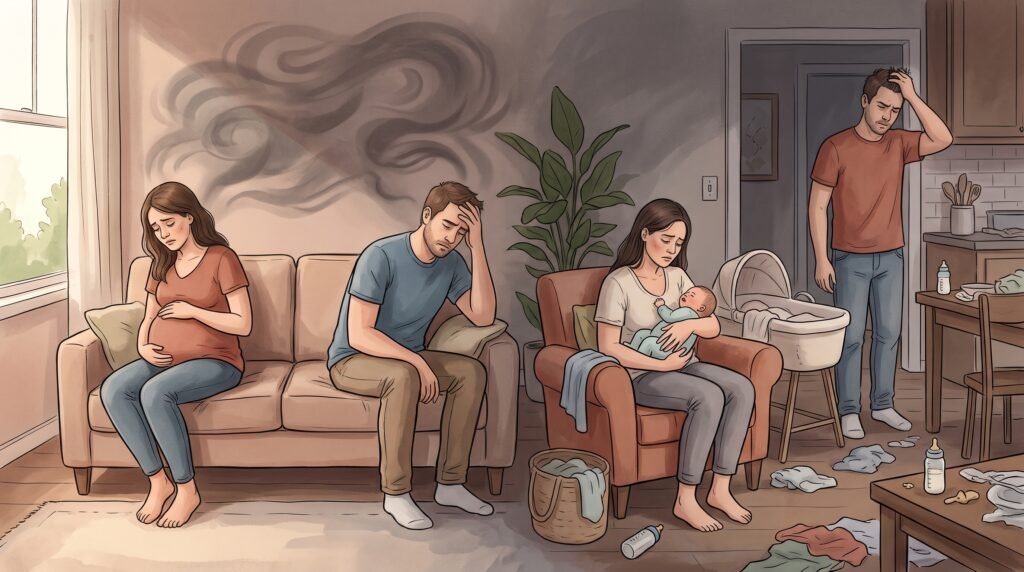
As a couples counselling practice, we are well placed to support both of you. Common themes include:
- Unequal mental and physical load, and the resentment it can bring
- Arguments driven by exhaustion, irritability or rage
- Changes in intimacy and sex after birth
- Different ways of coping with a difficult birth or loss
- Changing roles, identity and expectations from family and in-laws
- Deciding whether you are ready for another pregnancy
Partners often witness a frightening birth or emergency too. They may cope by trying to “move on” quickly, which can leave the birthing parent feeling dismissed. Couples sessions help each of you understand the other’s experience. Your safety matters: we screen for relationship abuse, and couples work is not used where there is ongoing violence.
Support for fathers and partners
About 1 in 10 fathers experiences perinatal depression. In men, it often looks like irritability, withdrawal, working longer hours or spending more time on screens, rather than sadness. Partners can feel shut out, under pressure to be “the rock”, or told their feelings do not count because they did not give birth. Your mental health matters too, and we welcome fathers and non-birthing partners in their own right.
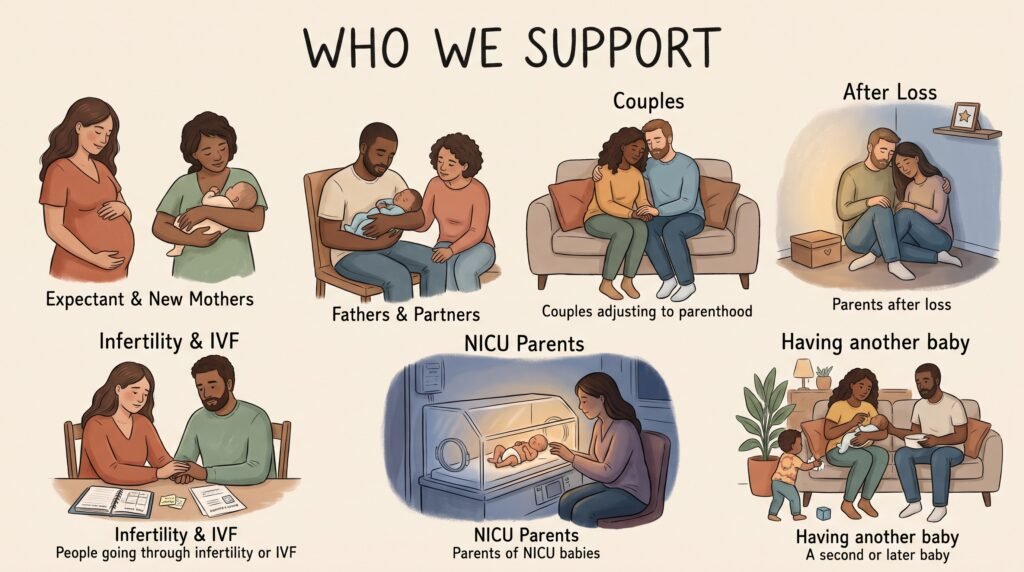
Who we support
- Expectant and new mothers, from pregnancy to the end of the first year and beyond
- Fathers and non-birthing partners
- Couples adjusting to parenthood
- Parents after pregnancy loss, stillbirth, TFMR or neonatal loss
- People going through infertility or IVF
- Parents of babies who spent time in the NICU
- Parents having a second or later baby, when difficulties can appear for the first time
Frequently Asked Questions
Perinatal counselling covers pregnancy and the year after birth. Postnatal (or postpartum) counselling refers only to the time after birth.
No. Perinatal depression and anxiety are common, treatable health conditions. They are not a sign of weakness or of being a bad parent.
Unwanted, intrusive thoughts are very common in new parents. When they distress you and you work hard to avoid them, that is a sign of anxiety or OCD, not a wish to cause harm. Therapy can help, and you can talk about these thoughts with us safely.
A healthy baby does not cancel out a frightening experience. Birth trauma is defined by how you experienced it, not by the outcome. Your feelings are valid, and they can heal.
Yes. Partners are welcome in individual sessions, and we also offer couples counselling focused on the transition to parenthood.
It varies. Many people notice change within a few sessions. Structured approaches such as IPT usually run for 12 to 16 sessions.
No. Support is helpful whenever it starts, and many people seek help months after symptoms began.
Take the first step
You do not have to wait until things feel unbearable to reach out. Contact us to schedule a confidential appointment, in person in Singapore or online.